
Binaries and correlation
We can define correlation coefficient between any two pairs of "binaries". And unless extremely high, correlation of A with B, and B with C, doesn't say anything about the correlation of A with C

At a party that I hosted recently, one guest got extremely disconcerted that several other guests were “voluntarily unemployed”, despite possessing stellar educational and professional credentials.
And so to try and understand them better, she started analysing their MBTI profiles. It turned out that some people present weren’t well-versed enough about MBTI, so when I returned from having poured myself another drink, I walked into a lecture on what MBTI is, and what all the categories and combinations mean.
It was like being back in business school once again. As we discussed, we started comparing each of the MBTI binaries to other binaries that we might be familiar with. Presently, someone responded that life is not a binary and so MBTI is inaccurate - something I endorse.
Addendum: The said person said I’ve missed out some critical details so I’m adding them in here. So this is how the conversation went. The person who was explaining to us about MBTI said “___ kind of people rely on knowledge, but _____ kind of people rely on power” (I was sitting down on my bean bag with my drink at this point, so I don’t know what the dashes are; and it doesn’ t matter here). Immediately there was an objection from the other end of the hall “I went to a school whose motto was ‘knowledge is power’. So does this mean that my entire schooling was a lie?” (I’m paraphrasing) And then the discussion got into binaries and non-binaries, and effectiveness of MBTI, and that MBTI predates this school by a few decades, and all such. Anyway, we can get back to programming now. End Of AddendumIntrovert-extrovert is not a binary
Stud-fighter is not a binary
etc.
Personality vs Situation
A few days later, one of the guests sent me this, likening it to my stud-fighter theory.
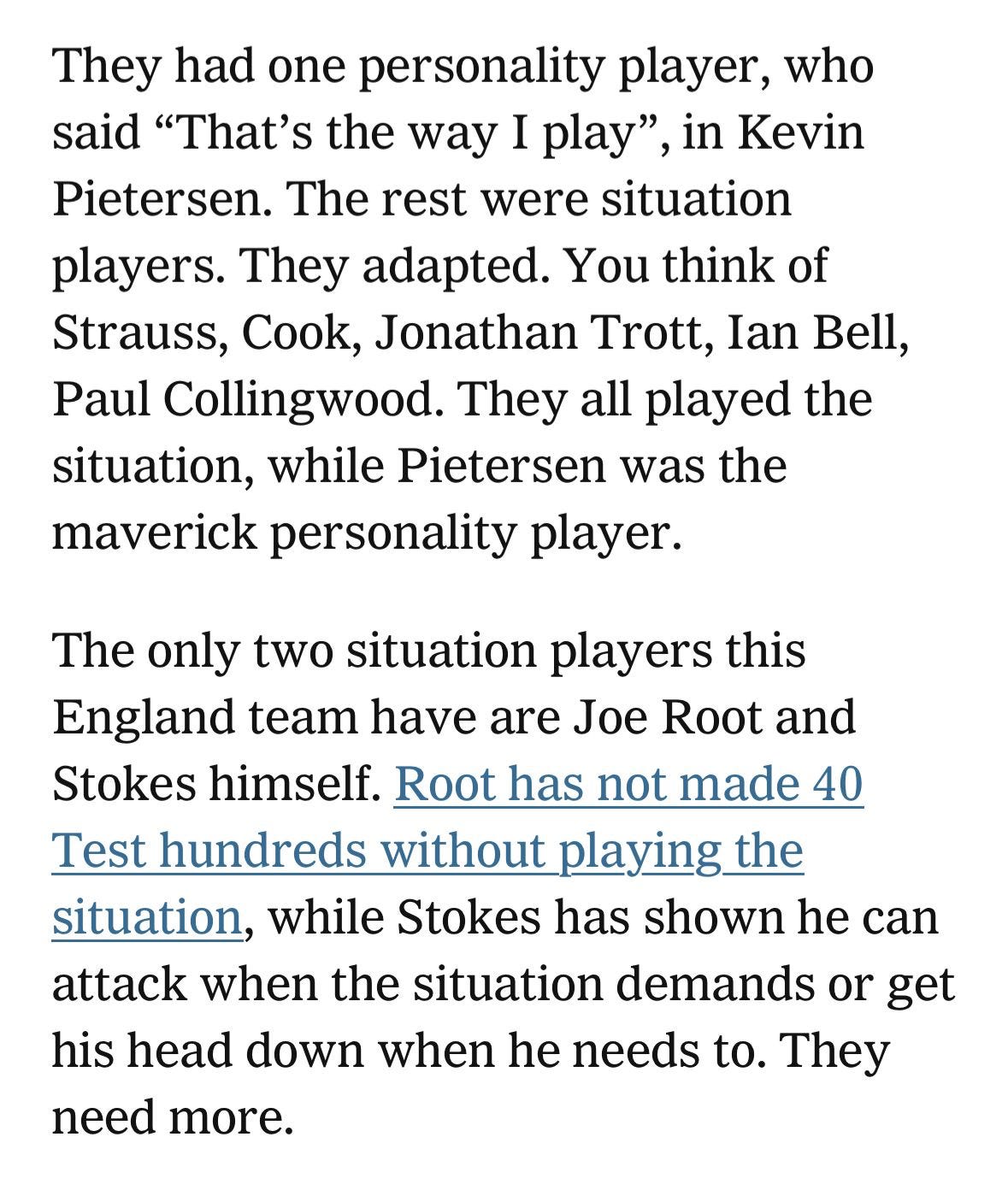
“More on the lines of stud = personality, fighter = situation”, he said.
This got me thinking. What Nasser Hussain has proposed above is a new binary - of “personality” versus “situation”. And that itself is interesting.
Some people are always the way they are. They don’t care about the situation and they just play the way they normally do. Others are more adaptive and suppress their natural game if the situation demands otherwise. Hussain’s complaint was that England now had too many “personality” players, which meant that the team was not adaptive enough.
Comparing Binaries
Given any pair of binaries, you can define correlation between them.
For example take the classic intelligent-stupid and lazy-diligent binaries (I’ve written about this before). The correlation is non-zero but not particularly high (intelligent people are marginally more likely to be diligent?).
Correlation is rather low (we will ignore sign since binaries don’t have direction) between beautiful-ugly and intelligent-stupid, and beautiful-ugly and lazy-diligent. On the other hand, correlation is likely to be rather high between beautiful-ugly and confident-notconfident.
I suppose you get the drift.
So I started thinking about this personality-situation binary, and comparing it to other similar binaries I’m familiar with.
One, that my friend mentioned, is stud-fighter. From my classic definition:
Ok so studs are people who have the knack of finding the easy way out. Who have the ability/knack of figuring out the shortest/easiest path.
Fighters are those who realize that they don’t have the innate studness that studs have. However, they are extremely ambitious and don’t want to be left behind because of the lack of studness. And they try to make up for it by sheer hard work. They regularly burn the midnight oil, cut down on their “other activities” and focus on the task at hand.
One way to look at this is that since fighters “lack inherent studness” (that was the 2007 me writing), they make up for it by “playing the situation”. On the other hand, studs, who “take the easy way out”, might find that playing the situation is the easiest way out.
So the two binaries are correlated, but they are obviously not the same.
Mindsets
There is this other popular binary, of people with “growth mindsets” and “fixed mindsets”. People with fixed mindsets have a particular world view that they refuse to change. And the general discourse is that this holds them back since they refuse to “grow”.
On the other hand, people with growth mindsets are far more malleable and adapt themselves as they learn new things. Unlike stud-fighter or situation-personality, this is a judgmental binary - one seems obviously better than the other.
My wife believes that I have a fixed mindset, for example, and that that has been holding me back professionally. This is possibly true, but the other thing that I think about is if this mindset binary is correlated to stud-fighter.
In any case, you can easily observe that there is some correlation between the mindset binary and the situation-personality binary. In a sense, “personality players” have a fixed mindset - they know one way of playing, which they are rather good at, and they will play that way irrespective of what the situation demands. Because they are inherently good (else they would have never made the team - this selection bias needs to be kept in mind) they end up making an impact in all kinds of situations, though less so when their personalities don’t fit the situations.
On the other hand, by being adaptable, situation players surely have a fixed mindset.
So we have concluded that there is positive correlation between mindsets and situation-personality, and between situation-personality and stud-fighter.
Comparing correlations
So does this mean that stud-fighter and fixed-growth mindset are correlated (likely with stud aligning with fixed mindset)? Can we estimate based on their mutual correlations with situation-personality what the correlation is?
The answer is that we can estimate but not put a tight bound. That A is positively correlated to B, and B is positively correlated to C, doesn’t tell us much about the correlation between A an C.
One way to think of it is in terms of vectors. Assume that A,B,C are vectors in some hyperplane. The correlation between A and B can be represented as the cosine of the angle between the two vectors. Similarly the correlation between B and C.
Knowing the angles AB and BC (we can call them that), we can put upper and lower bounds on the angle AC.
If AB and BC are both small (i.e. correlation between A and B, and between B and C are rather high - remember that cos(0) = 1), then we can put a relatively tight bound. In all other situations, the bounds on the correlation between A and C are rather loose.
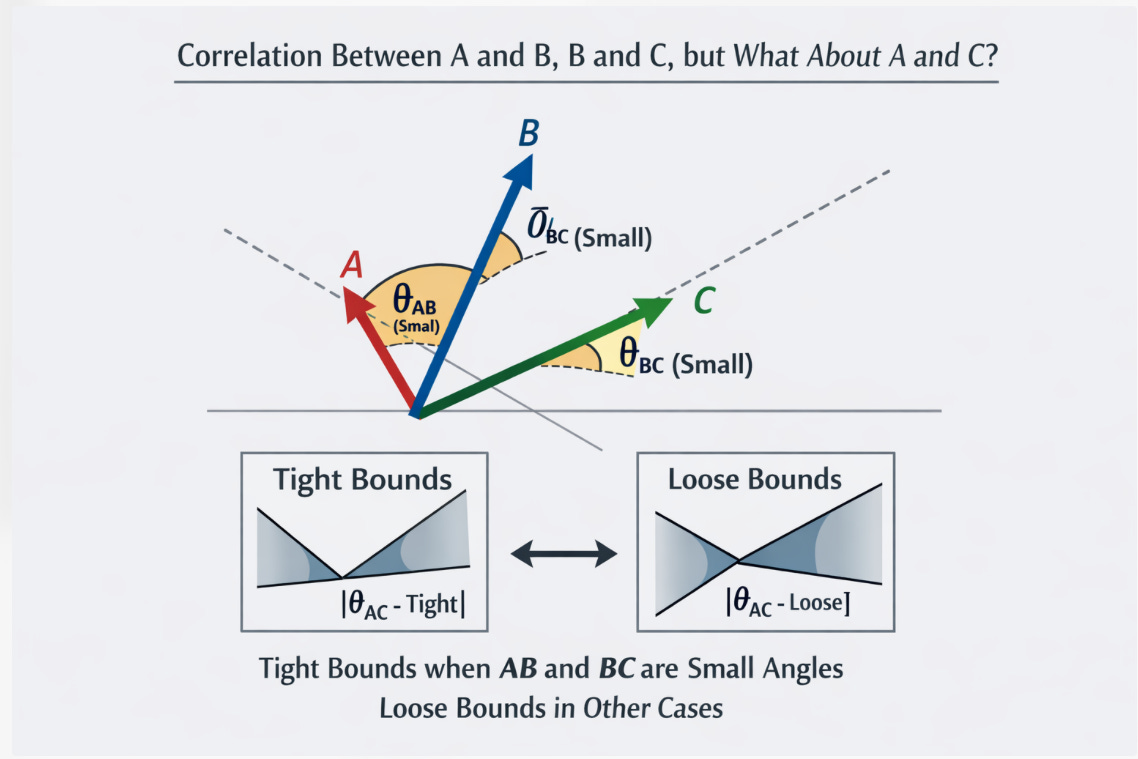
In our case, the correlations between mindsets and situation-personality, and stud-fighter and situation-personality are high, but not THAT high (correlation of 0.5 corresponds to a 60 degree angle, so if both correlations AB and BC are 0.5, then the angle AC can go anywhere from 0 to 120 degrees). That means we cannot say anything about these two correlations!
PS:
I tangentially mentioned above about a lot of observed correlations being results of selection bias. This deserves its own post, and will be written in due course of time.