
Credit and responsibility for AI creations
What makes AI art art? When does AI become a tool in the hand of the artist, and not the creator itself? The answer lies in "one touch"!

Back in 2008, I joined one of India’s earliest high-frequency trading (HFT) firms. This company had started just a few months after SEBI had legalised algorithmic trading in India. However, regulations were still tight.
If you wanted to send your orders directly to the exchange, you would have to get your algorithms “audited by the regulator” (forget now if it was SEBI or the exchange). As a startup building our initial (and fairly messy) algos, this wasn’t feasible for us. So we resorted to the next best alternative “one touch DMA (direct market access)”.
This was a service provided by our broker where we could send them the orders however we wanted (including algorithmically) and there would be a trader who would instantly approve it with the touch of a button. This act - of a human trader physically approving the trade - meant that the trade wasn’t algorithmic any more. We didn’t need to get our algorithms audited by the exchange any more.
I remember us joking in this office about a person our broker had employed, who had a keyboard with only one key, which he would be continuously hitting to send the orders through with minimal latency. There was no real human audit - but that there was someone approving the trades gave our algorithm cover. It is another matter that even this latency was enough to kill our arbitrage trades and we had to soon find new strategies.
I keep thinking back to this “one touch DMA” nowadays, in the context of AI and credit and responsibility.
Last week, I objected to a message on a WhatsApp group I’m a moderator of, saying “copy pasting LLM output here is disrespectful to the other members” (this was a clearly ChatGPT generated message, replete with random emojis and stuff). There was a very small back and forth, before the poster deleted that message, and then wrote a fresh message written “in his own words”.
I remember some other members of the group applauding the process, on how we had resolved the matter in a civil manner. And then someone else (another admin) chipped in to say “I don’t know what the problem with AI generated messages is. All my messages are AI generated. I’ve lost the ability to write independently now”.
This is where the ‘one touch DMA” analogy comes into play - this other admin might be using LLMs to craft his messages, but he has done something (“one touch”) that makes us believe that the words are his own. He might have used LLMs but the output is not directly LLM generated. He has “touched” it, or put his stamp on it, and now the message is his.
The problem with the original message that I’d objected to was that it was “untouched” and way too blatantly AI generated. And thanks to LinkedIn (in part), a lot of us have now got used to simply ignoring or discrediting obviously AI-generated stuff. And so for a group like the one I moderate, this is “noise” which doesn’t add value.
The same principle can be applied to look at other things such as AI art. Using AI for art is not a problem - like paintbrushes and MS Paint and photoshop, AI is just another tool that the artist uses, and that is legit. What is important is that the artist has given the art at least “one touch” beyond what the AI has produced.
For example, consider this cartoon I made last night using ChatGPT. The words are all mine - I wrote the entire script. I gave the script to ChatGPT and asked it to draw, and it produced this. Once it had produced this, I gave it a once-over, and I was happy with what it produced, and hence published it.
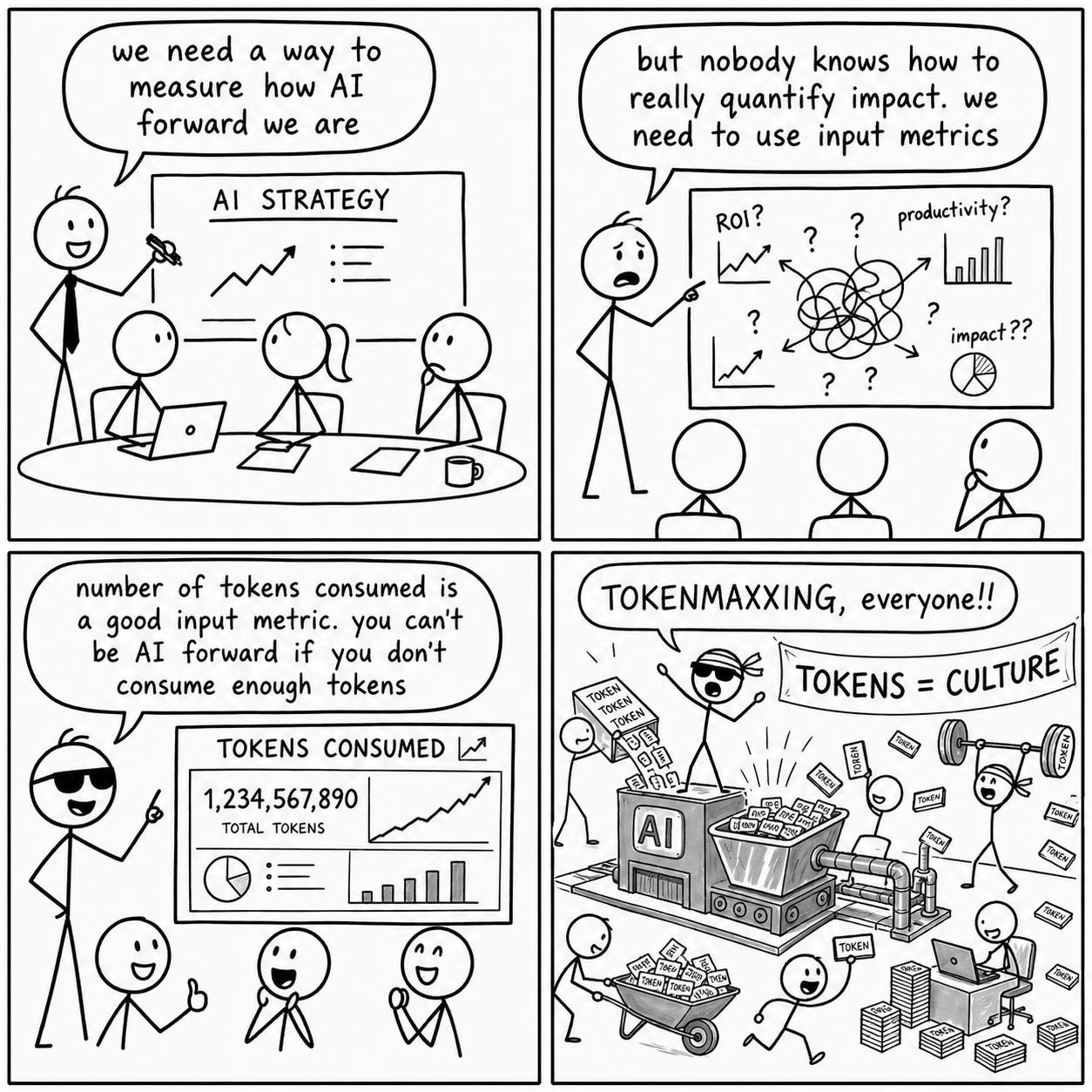
A year or two ago I would’ve been unable to produce this since I can’t draw particularly well. Now, using the tool called ChatGPT (which is clearly better than it was a year or two ago), I’ve been able to create this art. And this art is entirely mine - I got the idea for it, I wrote the prompt, I reviewed the LLM’s output and I decided to publish it. This is my artwork and nobody can take it away from me!
So what is it about all the outrage about AI art and AI music and stuff? To be honest, most “art” that AI produces is fairly unspectacular. This ties in why my hypothesis that “LLMs are beta” - when you give AI a weak prompt and ask it to produce art, it produces something that is “average of its training data in the direction of this prompt”. Most AI art is, in GenZ’s words, “mid” (maybe that’s why they called it midjourney?).
However, the moment you bring in that one touch, you are able to significantly elevate AI art. You provide better prompts. You prompt it back if you don’t like it. You iterate until you are happy with what you have. Your ideas, your improved prompts, your back-and-forth - this is the “alpha” that goes with the LLM’s “beta” and you create quality work.
The moment you give that one touch, AI becomes a tool. And the art becomes yours.
I’m working towards launching a suite of AI-written blogs (no, not this one - Pertinent Observations will always be written entirely by me, painstakingly typed out), and started thinking about what I need to do to make sure they are mine, and not “generic AI slop”. What is the “one touch” that I need to give to make sure they are of a quality I’m happy with?
In fact, thinking about it, as long as I think of those blogs as my outputs and me being responsible for their quality, I’m pretty sure I won’t put out anything that I’m not happy with. Which means those blogs will be of good quality.
Launching soon. I’ll mention here when I do.