

The movie version of Moneyball (it’s been way to long since I’ve read the book so I don’t know how it ends) ends with Billy Beane (played by Brad Pitt) travelling to Boston to meet John W Henry of the Boston Red Sox who tries to hire him. Beane declines and returns to run Oakland As.
A couple of seasons into Moneyball, Henry was already enamoured by the power of data science in sports (after all, he was a quant trader). So when he bought Liverpool FC a few years later, he quickly built up an analytics department under the new director of football Damien Comolli.
Comolli, among others, hired Ian Graham from Decision Technology (they had both worked together for Spurs) to run the data science team, and was indirectly (after some committee fiascos) succeeded as director of football by Michael Edwards, who is ex-Prozone and so from an analytics background (though more in a forward deployed role rather than a modelling role).
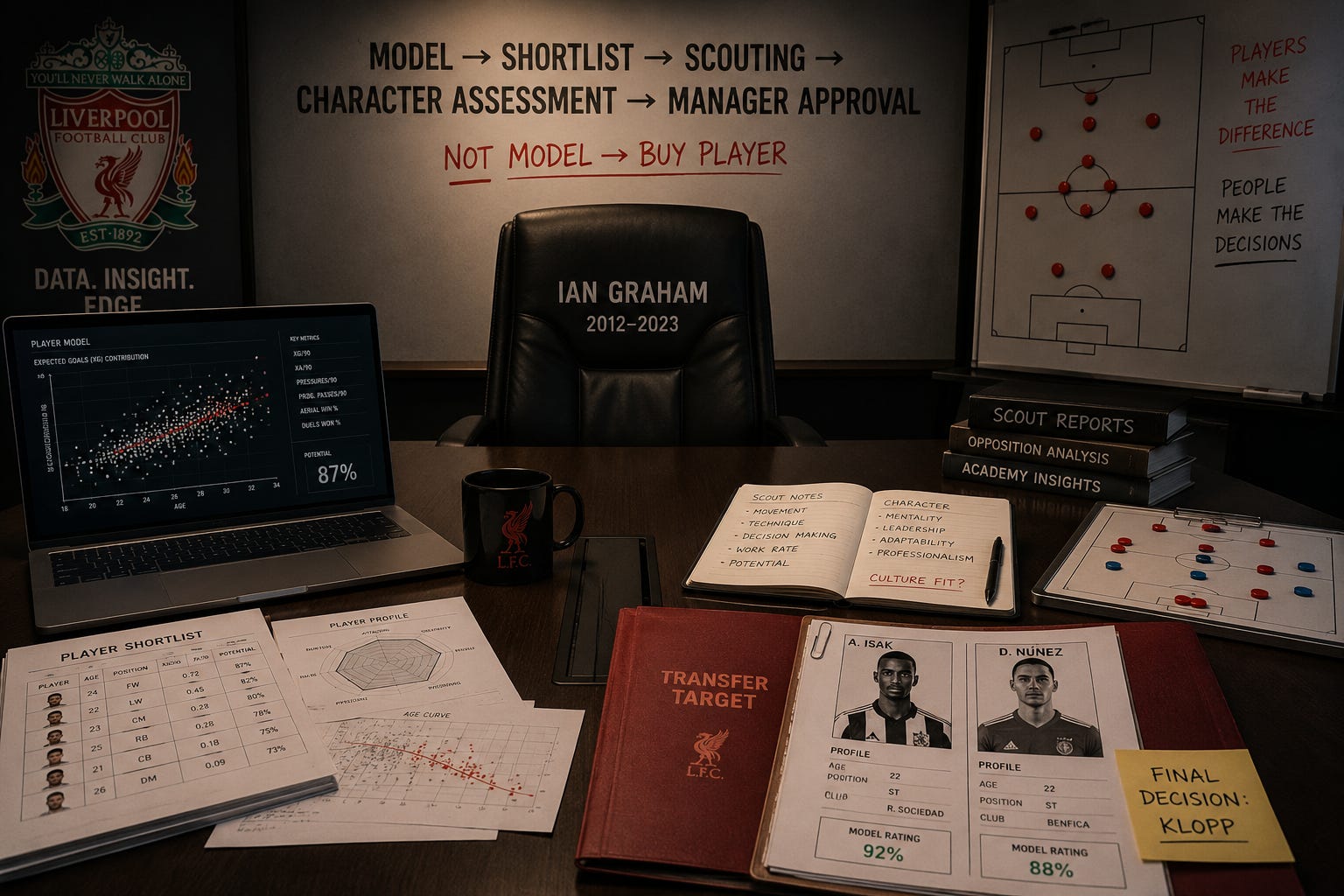
Graham led Liverpool’s data science until 2023 when he moved on, and wrote a book titled How to Win the Premier League. In that he made some interesting observations about how data science had guided the club over the years:
2017: Klopp wanted Julian Brandt, but the data suggested Mo Salah would be a stronger hire. They managed to convince Klopp and everyone knows how that turned out
2015: Brendan Rodgers wanted Christian Benteke while the data guys scouted Roberto Firmino. The club hired both, and Benteke got packed off soon after Klopp arrived. Firmino is a club legend.
2017: Andrew Roberson and 2016: Georginio Wijnaldum, coming in from just-relegated clubs, were terrific arbitrage opportunities identified by Graham’s team. Both finished as legends at the club
2022: Graham’s team had scouted Isak while Klopp plumped for Darwin Nunez. I loved Nunez during his time at the club, but his erratic finishing meant that in 2025, he got packed off to Saudi Arabia and Isak was hired (and he hasn’t been great so far - for Liverpool at least)
In any case, given the club’s recent struggles (post the title win of 2024-25), I’m starting to wonder if the club’s real problem lies in the data science department, especially in the post-Graham era. In fact, thinking about it, the drop-off in the quality of recruitment (and pursuit of statistical arbitrage opportunities) neatly coincides with the exit of Graham.
Could this be one key reason why the club is struggling?
Now, apart from being a Liverpool fan, I’m also a data scientist, and my domain knowledge there suggests why the club might be actually struggling to replace Graham.
Football is a classic case of “non-agentic data science” - the data model simply informs, it doesn’t really recommend. It is a necessary but not sufficient input into a fairly complex decision made on rather insufficient data. For the purpose of this blogpost I was getting ChatGPT to summarise Graham’s book, and it said:
His ideal process was:
Model → shortlist → scouting → character assessment → manager approvalnot
Model → buy player.
And in my post on non-agentic data science I’d written:
This interpretation is necessarily risky. The number of such decisions is small, but each decision is of extremely high impact. It is unlikely that one person makes the decision here - it often gets deferred to a committee, which the data scientist in charge is part of.
Typically, an empowered data scientist’s job here doesn’t end at producing the analysis - they are also responsible for interpreting it in the context of the company and business, and recommending a way of action. In a way, this is a riskier role, but a higher impact role.
This exactly fits the case with football, especially something as “lumpy” as transfer decisions - a very small number of very high impact (and high variance - look at Isak!) decisions. In football transfers, data science merely provides an “edge” (no certainty), and to translate the edge from the data science domain to the football domain requires strong collaboration between the business and data teams.
And in such setups, it is imperative for the data science teams (especially the leaders) to have great domain knowledge, since they need to go that extra mile to interface with the business people and talk in their language (it is generally much much harder for business people to really appreciate the intricacies of the data model).
A corollary to this is that in non-agentic data science setups, the skillset required for the head of data science is very different from the skillset required for his / her team - there is special emphasis on the head to be able to talk business (and we know that this isn’t something most data science leaders are particularly good at). So when the head moves on, promoting from within is not necessarily the right step - the deputy might be technically sound but that doesn’t really make them the right person to become the main person.
Now this is an analytical post and I didn’t want to go ad hominem, but I guess it’s better if I mention the name - did Liverpool miss a trick by appointing Will Spearman to succeed Ian Graham as the head of data science? Now, Spearman’s technical chops are unlikely to be in question (given Graham hired and groomed him), and despite being American, he had worked in “soccer” for a decade before becoming head of research at Liverpool.
This is pure speculation but - could he be missing the “business layer” that made Graham so good at his job (at turning data into business recommendations)? And could there now be a larger gap between the data and business teams (current Director of Football Richard Hughes is a former footballer, who doesn’t have the data background that his boss Michael Edwards (now CEO of football for Fenway Sports Group (that owns Liverpool and Boston Red Sox) ) has), which explains why the team is not able to pick out arbitrages like it used to?
I asked ChatGPT to name all “moneyball” players that Liverpool has hired and it said:
2023–Present (Post-Graham)
Not really Moneyball anymore. Liverpool are mostly buying established stars.
Alexis Mac Allister — closest thing to a classic Moneyball signing. World Cup winner but Brighton sold him below market due to a release clause.
Ryan Gravenberch — buy-low after a failed spell at Bayern.
while pointing out that the late Diogo Jota, who joined the club in 2021, was “possibly the last great Graham-era signing”.
There is something in the data here, which a lot of other commentary about the club has failed to mention!