
Has the Woke bubble burst?
I don't know if this headline follows Betteridge's Law

I’ve been following 37signals CTO David Heinemeier Hansson (DHH)’s blog for a very long time now, and I thoroughly enjoy his writing on all subjects. I also follow him on twitter.
For the last couple of days, my twitter feed has been full of a news report of an attempt to cancel him and fork Ruby on Rails, of which he is a major contributor, allegedly because of his “Nazi” views (possibly due to this blogpost of his, which I read and quite liked).
One of the first tweets on the topic to pop up on my timeline was this one by Shopify CEO Tobi Lutke (a heavy contributor to Ruby On Rails):
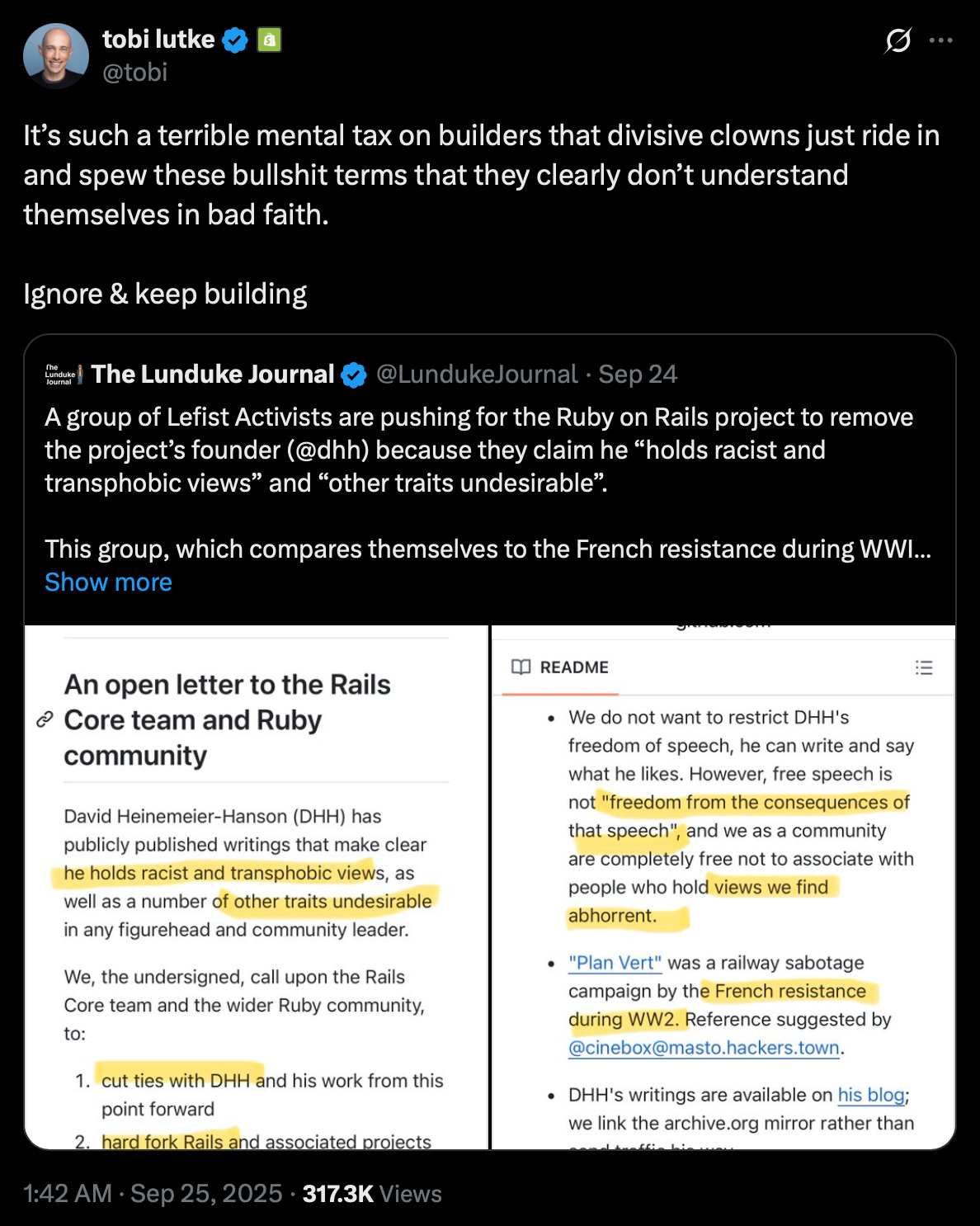
I couldn’t have imagined something like this in 2020, or even in 2017, when cancel culture was just beginning to take over.
Back then, if someone accused someone else of “holding bad thoughts”, it was very highly likely for the entire internet to pile on, and make sure that the cancellation was real. You could lose your job, and not get another one, thanks to such “online incidents”. Identity politics seemed to be “top of mind in the online world” and trumped (no pun intended) everything else.
A high profile tech CEO like Tobi Lutke coming in aid of his friend (and board member) who had been thus accused would have been very unlikely then - in those days, supporting someone accused would mean that you would also join the list of the accused. If the above tweet had happened in the 2017-21 window, we would have seen some high profile brands withdraw from Shopify (“I don’t want to associate someone who associates with someone accused of being bad”), and in anticipation of that, Lutke may not have written this in the first place.
The best description of cancel culture I’ve heard is from Jim O’Shaughnessy, founder of OSAM. I’m paraphrasing:
To understand cancel culture, you need to watch this wonderful movie called Mean Girls. Where they say “if you hang out with that girl, I cannot be your friend”
Anyway this is my attempt at thinking loudly at understanding wokism. I guess it started with noble causes, with people showing compassion and trying to fight against discrimination of all kinds. Along the way, they discovered that publicly shaming people for “doing bad things” or “thinking bad thoughts” was a winning strategy. Others would pile on with them. More importantly, people were now afraid of being publicly shamed, and so did “less bad things”.
This is how, for example, the #MeToo movement of 2018 took place.
The thing is this - there was this orthodoxy - a set of thoughts that would largely protect you from getting publicly shamed. It was like Pascal’s Wager - publicly holding woke thoughts only had benefits and few costs. And holding such thoughts publicly would also involve piling on when someone was being publicly shamed. Moreover, being publicly anti-woke would mean that you were drawing a target on yourself, and you wouldn’t want to do that.
So, on the margin, people became more (publicly) woke. There was no problem in doing that, and it gave one the feeling that you were part of the “circle”. Speaking for myself, it was around this time I started being more circumspect in what I would put out in public (though if you were to go into my blog archives, you’ll find enough material to cancel me on every single dimension possible).
It was a classic bubble, if you think about it. People became more (marginally) woke because it appeared that it was both costless and virtuous. And as more people became more work, it became more costless and virtuous. The virtuous cycle boomed, or so it seemed.
And the bubbliness comes from the fact that people weren’t inherently woke - they were only publicly woke because everyone else around them were publicly woke. And with anti-woke statements or thoughts coming at a cost, the bubble grew unchecked.
Until Trump won the 2024 election. Or was it when Elon bought Twitter in 2022, and a whole lot of the woke people decamped to BlueSky and Mastodon? I’m not sure, but in that time frame, the returns to being woke started diminishing, and the returns to being anti-woke in public went up.
Soon, it was okay to say anti-woke stuff in public. Suddenly you had the refutation of Pascal’s Wager where you also have a devil involved - now suddenly, devotion to god is no longer costless, and so Pascal’s argument doesn’t hold.
As some people started saying anti-woke stuff in public, it encouraged others on the same side to join them. Now, in a sense, the bubble started reversing. And that reversal has grown, it seems like.
A few years ago, an open letter like the one seen above would have brought hundreds of pilers on. Prominent people like Tobi Lutke would’ve never come in defence of the accused. At least on twitter, most stuff I saw was in defence of DHH and mocking the accusers (I also saw on twitter that on Bluesky and Mastodon, most discourse was in favour of the petition). There were also screenshots posted of one of the leaders of the group that wrote the open letter expressing despair that the petition didn’t receive much support.
I wonder if this is evidence that the wokism bubble has burst. It will never truly go away - there will always be a bunch of tr00 believers. However, the world seems saner than it used to be.
or is it?
I see the beginnings of right-wing wokism rather than a return to common sense. But it won't take over in a clear-cut way. Maybe people will feel more comfortable with a toned down LW wokism that ensures people are less mean to women and minorities, and this leads to just having to walk on different eggshells in different pockets again.
Any phenomenon in the US tends to go overboard and then birth its counter-phenomemon which then also goes overboard. Not sure common sense centrism is going to be back.