
How LLMs will change business intelligence
Thanks to LLMs, business intelligence will get hyper-personalised. Companies will be able to build dashboards for each user. And this can upend the entire BI market.

On Wednesday, I wrote about how LLMs change software engineering. This is the continuation of that, focussing on “my domain” that is business intelligence.

When it comes to business intelligence, here are my broad predictors on how the sector will evolve over the next few years:
Dashboards will become hyper-personalised.
The concept of the “dropdown” in dashboards will disappear.
Semantic layers will finally find their utility.
The hold of large GUI-based tools such as PowerBI and Tableau will go down. These platforms will themselves be forced to become more code-friendly
Before we get into the details, a short refresher of yesterday’s post, on what LLMs are doing to software development.
Thanks to LLMs, the cost of “build” (in the “build vs buy” debate) has come down significantly.
In fact, it has come down enough, that it is now feasible to build and maintain specific software for a single user, something that was unthinkable fairly recently
This kind of customised build is best done by someone who is close to the “business” or “user”. So we will see more software being either built in-house, or by bespoke consultants, and less of product purchases and system integration.
Keeping these principles in mind, let’s get to how BI might get disrupted in the process.
The Modern Data Stack is Reborn
People have been writing a lot about the death of the so-called “modern data stack”. I had written somewhere (not sure where) about how there was a lot of self-flagellation going on among the MDS vendors. Of course, there has been some consolidation, with Fivetran gobbling up everybody.
That said, my sense is that AI will actually be a massive tailwind for the MDS, and what we are seeing now is only a temporary blip.
During the Databricks summit in San Francisco this year, I was talking to the CEO of a company that can firmly be classified in the MDS bucket (and no, Fivetran hasn’t bought them (yet) ). We were talking about how data governance and lineage, and semantic layers; and discussed about how semantic layers haven’t (yet) taken off because of lack of integration from large BI systems (PowerBI, Tableau, etc.).
These systems are massive monoliths / walled gardens (choose your metaphor here), and have a massive distribution advantage (especially PowerBI, since from what I hear it is offered for free along with larger Microsoft 365 licenses). And they have been relying on that to establish their dominance, and have good reason to not integrate outside of their stack (Azure Data Factory in PowerBI’s case).
With LLMs, we will see a case for more personalised dashboards which means a greater emphasis on data governance and lineage and metric definitions. And this means semantic layers are going to become super important. Fivetran’s purchase of dbt will look extremely inspired from this angle alone.
Personalised Dashboards
When I started Babbage Insight two years ago, I interviewed leaders from a hundred companies (literally), trying to understand how they currently get insight from data. Only some 5 out of the 100 looked at their company dashboards daily. Here is an early match report after some of those interviews:

The complaints were many:
there are too many dashboards to look at
the dashboard UX is broken, and one needs to go through hoops of pages and tabs and dropdowns and other interactivity to see what one needs
the current dashboard format is not appropriate for a particular user’s use case, but that is the only data source
dashboards can take a very long time to load, and don’t work well on mobile phones
With LLMs, and the cost of “personal software” going down, a lot of this can be a thing of the past. It will be feasible commonplace for users to have their own personalised dashboards, based on precisely the metrics they want to track, using the kind of visuals that they prefer, delivered in a manner most comfortable to them (I expect companies to start implementing this first with the leadership, and then let it trickle down to the rank and file. The latter might be required to do some self-service at first, but we will get there).
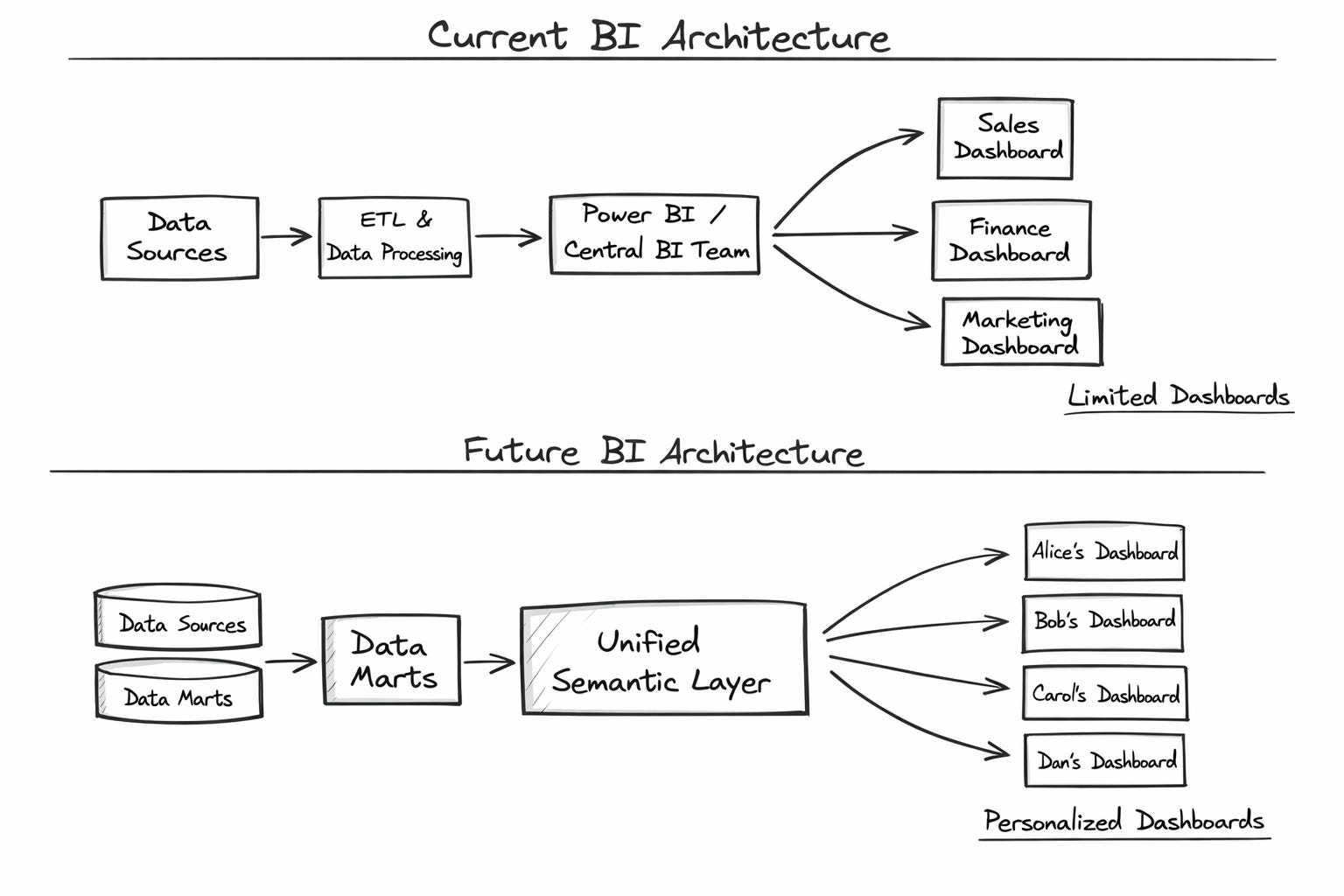
However, in order to have personalised dashboards, it is super critical to have a strong set of metric definitions - for all the numbers on everyone’s dashboards need to match one another. And this is where the semantic layers and strong metrics definitions come in.
What is likely to happen is that you have a set of data models and semantic layers that front the data warehouse. And then the BI team can pretty much (and rather easily) build personalised dashboards for every single user, using AI. All of these dashboards will run off the same data models and semantic layers, thus ensuring data consistency, while giving each user precisely what they need.
A move towards open source
The thing with existing BI tools is that they have all been built for the enterprise - where each dashboard is made by one central team, and then there are several people who use it (using dropdowns etc). These systems are not conducive for building bespoke personalised dashboards.
Also they are all visual tools based on GUI, which means it takes a long time to build (even if you were to use copilots etc.).
As we start using LLMs to build personalised dashboards, we will see a move towards open source or code-controllable dashboards (such as Superset or Metabase or even Retool). Those will be far easier to create and debug for LLMs, and they can be built off the centrally controlled semantic layers. Or, some of the more newer BI systems, such as Hex or Sigma might be able to do well here as well.
Also with each dashboards designed for a single user, things like dropdowns will disappear (remember that dashboards are tools to tell you WHAT is happening; they are NOT analysis tools). Visuals can be personalised to what the users want, with their preferences taken into account.
Large players such as Tableau and PowerBI will start losing marketshare thanks to this, and they will adapt, to make themselves more nimble. They will separate out their semantic layers (and even start supporting external semantic layers), and allow for more code-first approach to building dashboards, so that LLMs can use them to build personalised dashboards. And they will gain back some of the marketshare they would have lost.
How we will get there
It is not going to be easy or quick. Large dashboarding tools have massive holds on their enterprise customers, since right now it’s all a lot of monolithic purchase by the IT team.
Here is one way in which we are going to get to the situation above. It will take a few years.
Basically some enlightened companies will start building personalised dashboards for their execs / users. This will require execs exerting influence over the IT teams to allow for the necessary set of tools to be built and bought to enable this. But we can be sure that a small % of execs are enlightened enough to enable this.
Then, there will be cross-pollination and execs / users at other companies will start putting pressure on their IT teams for similar personalised services, and they will start moving to more “compatible” tools (semantic layers + open source dashboarding tools). It will be, for a while, largely user led rather than IT led.
And then, over a period of time, it will become cool for IT and BI teams to adopt this new personalised paradigm for building dashboards. That is when the hyper personalised era of dashboards is going to take off.
Exciting times ahead! What do you think?
After many many exasperating conversations with CXO level folks, I have come to the following realization : They do not care about data analytics, the number one thing that they seem to care about is - whether everyone (i.e their peers and the CEO) can agree on a metric. And this agreement is driven by a dashboard which is common to all. These folks do not care about personalization as they don't spend time interacting deeply with a dashboard. They only care about consensus. The person who is actually 'playing with the data' , somebody like a CXO chief of staff might have some needs for a personalized dashboard but that is used for prep before their discussion with the CXO using the common dashboard. Sorry, I might be sounding cynical but basing this on my experience :)
Excellent writeup and observation, Karthik. Having been through this myself, I agree that open-ended solutions allowing users to customise their own dashboards makes perfect sense from a user adoption perspective.
However, I'd add one caveat: if we want to align decision-makers & guide teams toward common goals and metrics, we still need some default metrics alongside personalised dashboards. This balance helps maintain organisational coherence while enabling individual flexibility.
That said, I'm completely with you on the technology implementation side. The traditional approach of spending millions (literally, in some cases) with contractors or system integrators to develop 100-150 dashboards, where only 1% actually get used, is fundamentally broken. LLMs offer a much more sensible path forward.